
The trouble with dry ice as a bed bug activator, and what to use instead
By Skatek · · 3 min read
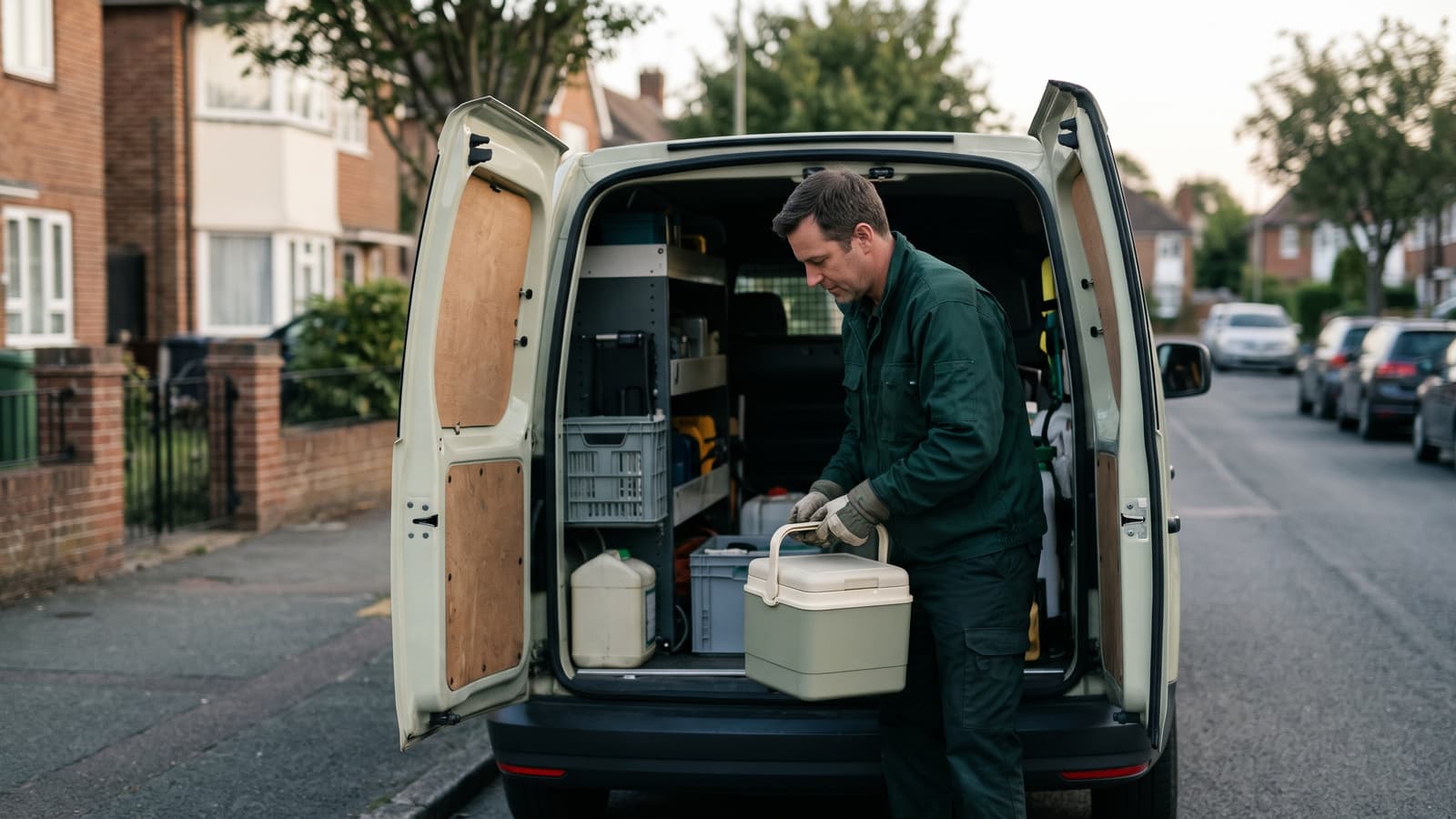
Technicians use dry ice to activate bed bugs: the CO₂ draws them out of hiding and into the interceptors and traps already in the room. The job around it is hard: getting the ice, carrying it, leaving it in a client's home and having it release on the right night. ExHale gives the room the signal of a sleeping person from an aerosol, on a schedule you set, with no ice to handle.
Why use CO₂ at all?
CO₂ was the strongest single attractant for bed bugs in lab tests, clearly ahead of heat (Wang et al. 2009). Bed bugs follow it to find a sleeping host, which is why technicians reach for dry ice. ExHale builds on the same principle and adds kairomones, the other compounds in human breath. The question is how you deliver the signal on the job.
What makes dry ice hard on the job?
It is hard to get in many areas (Wang and Cooper 2012) and turns to gas from the moment you collect it, so you can't stock it in the van. You handle it with insulated gloves or tongs and never seal it, because the pressure can burst the container (University of Edinburgh). In a confined room, high CO₂ concentrations are a real hazard (HSE), and researchers at Rutgers named injury risk as the main drawback of dry ice (Wang et al. 2011).
Then there is timing. Bed bugs are mostly active after lights out (Romero, Potter and Haynes 2010), but dry ice releases CO₂ from the moment you put it out until it is gone. Put it out at ten in the morning and much of the CO₂ goes out in daylight. Every extra night, and every after-control, means another supply run.
How does ExHale do the same job?
ExHale gives the room the signal of a sleeping person without the ice. A 184 ml aerosol holds CO₂ and kairomones, the compounds in human breath that bed bugs follow to a host. A programmable dispenser releases it at the hour, minute and days you choose.
| Dry ice | ExHale | |
|---|---|---|
| Signal | CO₂ | CO₂ and kairomones from human breath |
| Supply | Collect on the day, it starts to disappear | An aerosol can you bring with you |
| Handling | Gloves or tongs, unsealed box | Load the can, set the schedule |
| Timing | From the moment you put it out | Only at the hours you set, such as 23:00 to 04:00 |
| Several nights | New ice and a new visit each night | Set the days on the same dispenser |
| After treatment | Source the ice again | Same setup, same positions |
Does it draw bed bugs out? Skatek commissioned two independent studies in 2025. In a furnished bedroom in the UK, bed bug activity was recorded on all five nights ExHale ran; on the night without it, a single bed bug left its hiding place. At UC Riverside, about twice as many bed bugs came out of hiding on the night ExHale ran (+108%), against +8% in the control group. Read the study summaries.
ExHale is a monitoring tool and contains no pesticides. Use it before treatment to confirm where the bed bugs are, and after treatment to show the client the job worked.
If you still use dry ice, a checklist
- Collect it on the day you use it and carry it in an unsealed, insulated box, out of the cab.
- Handle it with insulated gloves or tongs.
- Put it in an insulated container, lid slightly open, near the bed and your interceptors, out of reach, and tell the client what it is.
- Record when you set it, where, and what you found.
FAQ
How long does dry ice last for bed bug inspections?
In the Rutgers study, about 1.1 litres of pellets in an insulated jug released CO₂ for 12 to 15 hours at 23 to 25°C (Wang et al. 2011).
Is ExHale a treatment?
No. ExHale is a monitoring tool. It shows whether bed bugs are present before treatment and whether they are gone after it.
Want to see how ExHale fits your inspections? Book a 30-minute intro call or find a distributor near you.