Your technician shouldn't have to sleep in the client's bed
By Skatek · · 4 min read
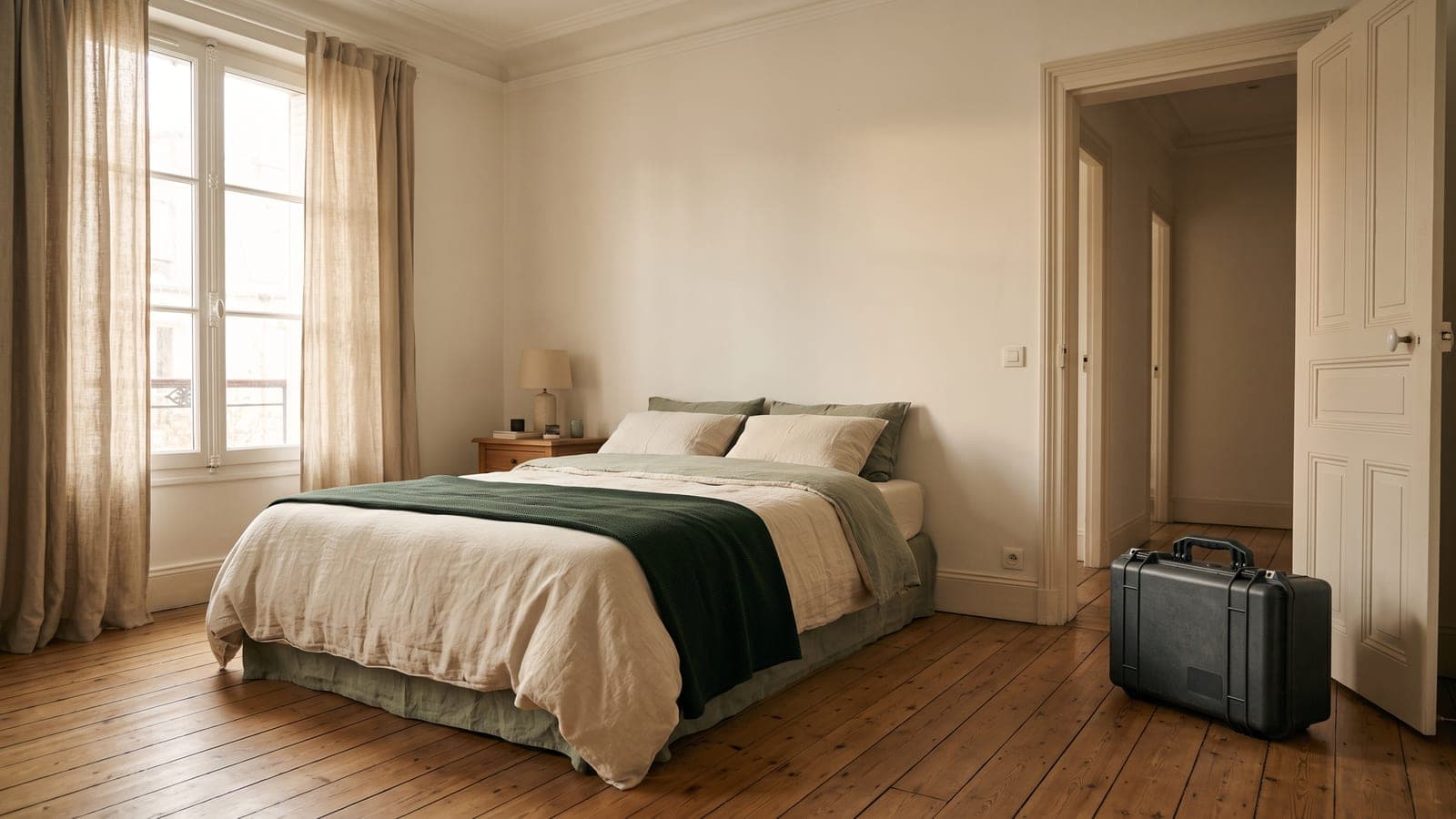
Bed bugs leave their hiding places when they sense a sleeping person nearby: the carbon dioxide in their breath, their warmth and their skin odours. That is why some companies still send a technician to spend the night in the client's bed. You can give the room the same signal without a person in it, and on a schedule you set.
Why do bed bugs stay hidden when nobody sleeps in the room?
Without host cues, bed bugs are mostly active in the dark and seem to search only when a host is actually there (Romero, Potter and Haynes 2010). Raising the CO₂ level in a room, as a sleeping person would, made bed bugs more likely to leave their refuge and start looking for a host (Hentley et al. 2017).
An empty room gives them none of that, and the Bed Bug Foundation warns that monitoring can give false negatives in unoccupied rooms for this reason (PPC Online). Cold makes it worse. Below about 13°C bed bugs become inactive (PPC 115), so a cold flat between tenants can look clear when it isn't.
Why do companies end up using a technician as bait?
The client wants an answer and the usual tools often can't give one. A full visual inspection can take two experienced technicians several hours and still miss low numbers (Wang et al. 2009). In a survey of 2,372 apartments, brief visual checks found about 72% of the infestations that were there (Entomology Today).
A hotel room with one complaint and nothing visible. A flat between tenants. A recheck where the client asks if you are sure. A person in the bed is the strongest host signal there is, so some companies send a technician for the night.
What does a night as human bait cost your team?
- It only works if the bed bugs feed on your technician. Few people join pest control expecting that.
- A whole night goes on one room, and the technician is tired the next day.
- It is lone working at its hardest. In a 2024 survey of UK pest professionals, 87% had experienced work-related stress or anxiety and two thirds felt lonely or isolated at work (BPCA).
- One quiet night proves little, and it is hard to repeat before and after treatment.
What can replace the person in the bed?
CO₂ was the strongest single attractant in lab tests, ahead of heat (Wang et al. 2009). Adding a host odour lure to CO₂ increased catches, while extra heat made no significant difference (Singh et al. 2012). In infested apartments, one active monitor with CO₂ and a lure, left for a single day, caught as well as six to eighteen passive interceptors left for eleven days (Singh, Wang and Cooper 2015). The release rate matters most: a weak CO₂ source gives you the same quiet night as an empty bed (Wang and Cooper 2012).
| Method | Empty room? | Watch for |
|---|---|---|
| Visual inspection | Yes | Slow, unreliable at low numbers |
| Passive interceptors | Poorly | Nothing draws bed bugs out (Wang et al. 2011) |
| Dry ice | Yes | Hard to get, a risk to children and pets |
| Technician as bait | Yes | One room, one night, a heavy cost to the person |
| Scheduled CO₂ and host odour | Yes | Run it at night, ideally over several nights |
How do you make a room read as occupied?
- Inspect the bed, headboard, seams and nearby furniture first.
- Place the host signal near the sleeping area, and your traps or interceptors where bed bugs will pass.
- Run it at night, over several nights if you can.
- Check the temperature. A room near 13°C stays quiet whatever you do.
- Write down what you placed, where, for how long, and what you found.
After treatment, repeat the same setup in the same places. That is your after-control, with a like for like comparison to show the client.
We built ExHale for this job. It is a programmable dispenser with an aerosol that imitates a breathing person through CO₂ and kairomones. You set the hours and days it releases, so the room reads as occupied at night with nobody in it. It contains no pesticides and is used before and after the treatment itself.
What do you tell the client?
Tell them an empty room is not proof of a clear room, and how you will check. The BPCA Code of Best Practice says pesticides must not be used when a survey finds no evidence, but a monitoring programme can be set up, with a report after every visit (BPCA). A written record is easier to stand behind than "we had a look". Skatek Hub keeps those notes, photos and follow-up visits in one place, with or without ExHale.
FAQ
Does dry ice work for bed bug inspections?
Yes. In one field comparison a simple dry ice trap was the most effective active monitor tested (Wang et al. 2011). The hard parts are getting it, handling it safely and running it at the right hours.
Is ExHale a treatment?
No. ExHale is a monitoring tool. It contains no pesticides and is used before treatment to find out whether bed bugs are present, and after treatment to check the result.
If you'd like to see how ExHale fits into your inspections, read about how it works or find a distributor near you.